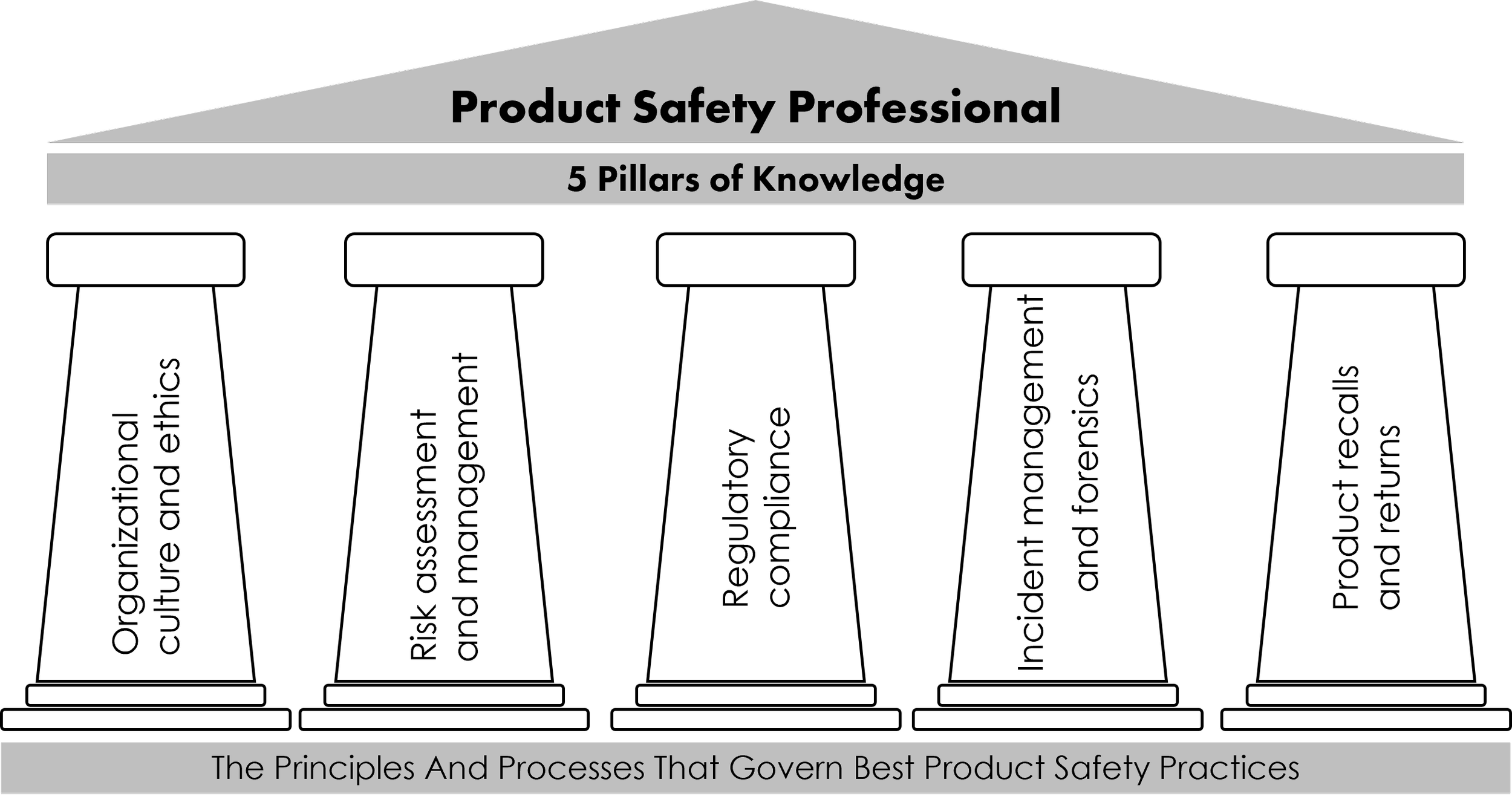
The Five Pillars of Knowledge define the principles and processes that govern best practices in product safety.
They serve as the foundation for all SPSP® educational programs and provide a common framework for developing, assessing, and advancing product safety knowledge, decision-making, and professional practice.
1. Organizational Culture and Ethics
Enables professionals to influence leadership, embed product safety into decision-making, and uphold ethical responsibility for consumer protection.
Focuses on establishing and sustaining a company-wide commitment to product safety and consumer protection.
● Corporate Product Safety Policy - Development and communication of product safety policies to all stakeholders, with advocacy for support from senior management and corporate leadership.
● Advice to Leadership - Provides safety-related, fact-based assessments and recommendations for corrective actions regarding product designs, production alterations, and products in the field. Communicates the need to reduce or eliminate foreseeable product safety risks, escalates safety issues to corporate risk leadership and officers, and works with company officials and legal counsel to determine whether incidents should be reported to regulators under applicable statutes and internal product safety policies.
● Ethical Conduct - Participates in and advocates for a product safety mission that includes ethical conduct and behavior. Elevates consumer safety in corporate decision-making, supports training of product safety personnel, and promotes respect within and outside the organization for its commitment to product safety.
2. Risk Assessment and Management
Enables professionals to identify, evaluate, and reduce product safety risks before products reach or impact consumers.
Focuses on identifying, anticipating, and mitigating product hazards and safety risks throughout the product lifecycle.
● Product Hazard Assessment - Assessment of product information, market data, published literature, incident claims, litigation, online product reviews, and other sources of field data to identify potential product hazards and safety risks. Ensures product safety is considered in all relevant corporate processes, including product design (with consideration of foreseeable consumer behavior), manufacturing, customer service, marketing, and field service. Evaluates processes, test methods, standards, and product instructions for safe use.
● Risk Anticipation, Identification, and Evaluation - Anticipates, identifies, and evaluates potential risks in new and existing products through participation in design and development processes. Ensures product designs integrate consumer use behavior, including foreseeable misuse, into final decisions. Collaborates with product managers, development teams, customers, retailers, distributors, and service providers on product safety issues. Applies analytical tools such as DFMEA, PFMEA, criticality analysis, fault trees, and risk sensing analytics to predict and minimize product safety risks.
● Third-Party Certifier Management - Coordinates testing to validate product compliance with mandatory and voluntary safety standards. Manages and maintains Good Laboratory Practices for qualified laboratories supporting product safety certification and self-certification where appropriate.
3. Regulatory Compliance
Enables professionals to ensure products meet applicable safety laws and standards across all markets and to respond effectively to regulatory requirements.
Focuses on understanding and applying product safety laws, regulations, standards, bans, and restrictions.
● Regulatory Knowledge and Communication - Maintains knowledge of applicable product safety rules, regulations, standards, bans, and restrictions. Uses reliable information sources to stay current and communicates product safety requirements internally and across the supply chain.
● Global and Market Awareness - Maintains awareness of regulatory requirements across applicable markets, with emphasis on the United States at the federal, state, and local levels. Engages with industry associations to stay informed of changing product safety laws and standards, participates in standards development activities, and contributes to industry discussions when appropriate.
4. Incident Management and Forensics
Enables professionals to detect, investigate, and respond to product safety incidents and determine root causes to prevent recurrence.
Focuses on identifying, analyzing, and responding to product safety incidents and failures.
● Incident Data Systems - Ensures a comprehensive corporate system through which all product safety-related complaints, incidents, injuries, lawsuits, liability claims, and warranty claims are compiled and managed.
● Investigation and Escalation - Manages and maintains systems to investigate, evaluate, and act on product safety incidents, including escalation processes for reporting, product recalls, and corrective actions such as product redesigns and production changes.
● Monitoring and External Data Sources - Monitors field complaints received through multiple channels, including customer communications and social media, for indications of product safety issues. Maintains working knowledge of consumer safety information sources such as CPSC SaferProducts.gov, NEISS, and other regulatory databases, and reviews relevant product recalls for similar products.
● Root Cause Analysis, Forensics, and Human Factors - Manages resources to forensically determine root causes of product failures, evaluates the effectiveness of corrective actions, and maintains records necessary for product safety decisions. Incorporates knowledge of human factors and consumer interaction with products, including how foreseeable use and misuse contribute to safety outcomes.
5. Product Recalls and Returns
Enables professionals to execute effective product recalls and corrective actions that protect consumers and ensure regulatory compliance.
Focuses on executing effective product safety corrective actions, recalls, and withdrawal systems.
● Corrective Actions and Product Withdrawal - Manages product recalls and corrective actions, including communication and coordination of product sales and shipping holds, reverse logistics, and engagement with regulatory agencies and internal stakeholders.
● Consumer Communication and Remediation - Oversees communication of product hazards, defects, or failures to consumers. Manages systems for separating consumers from hazards, including repair, replacement, repurchase, and disposal, as well as modification of future production to eliminate identified product safety risks.
● Inventory Control and Participation Management - Designs and maintains systems to control affected inventory and implements compensation or incentive structures to encourage participation in corrective actions and product withdrawals.
● Reporting and Recordkeeping - Monitors and reports product safety corrective actions as required by law. Maintains records for product destruction, returned inventory, repaired or refurbished products, and other recall-related activities.
● Continuous Improvement and Lessons Learned - Communicates lessons learned and conducts post-mortem reviews of product safety corrective actions and withdrawals with internal teams and external partners to strengthen future product safety performance.